On-page discovery

The guide appears where the question does.

An admin pins a guide to the button, form or menu it explains. Everyone on your team then sees a quiet Stepwright mark there: hover for what it covers, click to read it or be walked through it.

Included in Teams. Runs in the browser extension.

Step 1 of the guide: the board “Harbor Digital: Request Intake” highlighted in a monday.com sidebar, with the pointer on it.

How Pin Me works.

The hardest part of internal documentation is not writing it, it is being remembered. Pin Me attaches a guide to a specific element on a web page: owners and admins place the pin, and every signed-in member of the organisation then sees a small mark there, hovers it to see what the guide covers, and opens either the written guide or an interactive Guide Me walkthrough.

01 / 04

An admin pins a guide to the page it belongs on

With the extension, an owner or admin picks an element on a page, a button, a form, a menu item, and attaches an existing guide to it. The pin is stored against your organisation and that page, not the person who placed it.
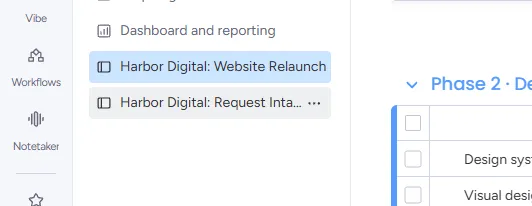
Step 1 of the guide: the board “Harbor Digital: Request Intake” highlighted in a monday.com sidebar, with the pointer on it.

02 / 04

Everyone on your team sees the mark

Any signed-in member of your organisation sees the Stepwright mark on that element when they visit the page. It is a quiet hint that documentation exists here, shown at the moment it is relevant rather than filed in a wiki nobody opens.

Step 1 of the guide: the board “Harbor Digital: Request Intake” highlighted in a monday.com sidebar, with the pointer on it.

03 / 04

Hovering shows what the guide covers

The pin expands into a small card with the guide’s title and description, so someone can tell whether it answers their question before opening anything.

04 / 04

From there, read it or be walked through it

The card offers View, which opens the written guide, and Guide Me, which walks the person through the process on the page they are already looking at.

Step 1 of the guide: the board “Harbor Digital: Request Intake” highlighted in a monday.com sidebar, with the pointer on it.

Why it matters.

Documentation that finds the person, instead of the other way round.

No searching, no wiki archaeology

Nobody has to know the guide exists, what it is called or which folder it was filed under. It is there on the page it describes.

Placed by admins, seen by everyone

Only owners and admins can pin, so a page stays curated rather than accumulating clutter. Everyone in the organisation sees what has been pinned.

Straight into interactive playback

Because a pin is clicked on the very page it is anchored to, Guide Me can start immediately rather than working out where to send you.

Adjustable without re-pinning

An admin can nudge a mark into a better position if it sits awkwardly, and the pin keeps its identity and its link to the guide.

Scoped to your organisation

Pins are visible only to signed-in members of the organisation that created them. Nothing is exposed to the public or to other companies using the same tool.

Attached to the element, not to a spot on the screen

A pin is anchored to the control it explains rather than to pixel coordinates, so it is not tied to wherever that control happened to sit on the day it was placed.

Teams. Placing, moving and removing pins requires the owner or admin role; every member of the organisation can see and use the pins that have been placed.

No. Pinning is limited to owners and admins so pages stay curated — a page accumulating pins from everyone would quickly become noise rather than a hint.

Yes. Pins are shown by the Stepwright extension in Chrome or Edge. Without it, the page looks exactly as it did before.

No. Pins are scoped to your organisation and only appear for signed-in members of it. Someone without the extension, or signed in to a different organisation, sees the page exactly as it always was.

A guide can be pinned to one element, and a page can carry pins for several different guides. If you pin a guide that already has one, Stepwright moves the existing pin rather than creating a second.

Try it on one of your own processes.

Record something you would otherwise explain on a call, and see what comes out. The free plan needs no card.